


Rizpah – The Grieving Mother
Click here for more Mother’s Day Sermons.
Click here to return to the Sermons page.
Click here for Famous Mothers in the Bible Series
Note: If you found this sermon series helpful, would you consider purchasing it as an ebook or print book? Thank you! Click the image to view on Amazon.

Click here for more books in the Understanding God’s Word series.
—————–
2 Samuel 21:1-14
INTRODUCTION: Our message series is called “Famous Mothers in the Bible,” and today we come to a mother who is probably not as well-known as many of the others in the series. In fact, many of you may never have heard of her at all. And that’s a shame because her story is a beautiful and important one. Her name is Rizpah. Rizpah is an example of a grieving mother, and her story teaches us important truths for parents who have lost a child. And even though this is a Mother’s Day message, Dads, this is for you, too, as we will be looking at examples of fathers who lost their children as well. (Read 2 Samuel 21:10 and pray.)
—————————–
Most of us have probably never heard of Rizpah before. That’s okay. She only shows up in this passage, and we don’t hear her talked about as much as some of the other mothers in the Bible. Sadly, this can be true of mothers and fathers who have lost their children as well. Because our children have gone on to be with the Lord, we sometimes feel like we and they have been forgotten. But God knows, God remembers, and today as a church we want to remember as well.
Rizpah was one of King Saul’s wives in the Bible, and she had two sons named Armoni and Mephibosheth. This is her story of loss and grieving, but it is also a story of honor, remembrance and hope. And as we look at her story and the other Scriptures this morning, I pray that you will see God’s heart for the grieving parent. Just the fact that God chose to include her story in Scripture shows how much God cares for parents who have lost their children. God offers comfort to grieving parents, and God offers comfort to you in the loss of your child.
I. Loss (1-6)
The first part of Rizpah’s story has to do with loss. Look at verses 1-6 with me which gives us the background for her story:
During the reign of David, there was a famine for three successive years; so David sought the face of the Lord. The Lord said, “It is on account of Saul and his blood-stained house; it is because he put the Gibeonites to death.”
2 The king summoned the Gibeonites and spoke to them…. 3 David asked them, “What shall I do for you? How shall I make amends so that you will bless the Lord’s inheritance?”
4 The Gibeonites answered him, “We have no right to demand silver or gold from Saul or his family, nor do we have the right to put anyone in Israel to death.” “What do you want me to do for you?” David asked.
5 They answered the king, “As for the man who destroyed us and plotted against us so that we have been decimated and have no place anywhere in Israel, 6 let seven of his male descendants be given to us to be killed and exposed before the Lord at Gibeah of Saul – the Lord’s chosen one.” So the king said, “I will give them to you.” (2 Samuel 21:1-6)
Rizpah lost her sons due to the sinful actions of Saul, God’s judgment on the land, and the Gibeonites’ desire for revenge. This was a tragic loss of Rizpah’s sons, as is the loss of any child.
A. The loss of a child is unlike other losses
– Genesis 37:34-35; Ruth 1:20-21; 2 Samuel 18:33
The loss of a child is unlike other losses. It’s been said: “A wife who loses a husband is called a widow. A husband who loses a wife is called a widower. A child who loses his parents is called an orphan. There is no word for a parent who loses a child. That’s how awful the loss is.” (Jay Neugeboren, “An Orphan’s Tale”)
The loss of a child is something we carry with us all our lives. Joseph Bayly, who lost three sons of his own, tells of meeting a man in his seventies. He relates: “During our first ten minutes together, he brought the faded photograph of a child out of his wallet – his child, who had died almost fifty years before.” (Joseph Bayly, The View from a Hearse, p. 51)
The Bible describes the loss of children in many places. We read of Jacob’s response when he believed that his son Joseph had been killed: “Then Jacob tore his clothes, put on sackcloth and mourned for his son many days. 35 All his sons and daughters came to comfort him, but he refused to be comforted. ‘No,’ he said, ‘in mourning will I go down to the grave to my son.’ So his father wept for him.” (Genesis 37:34-35)
When Naomi lost both of her sons and returned home, she told her fellow villagers: “Don’t call me Naomi, call me Mara, because the Almighty has made my life very bitter. 21 I went away full, but the Lord has brought me back empty.” (Ruth 1:20-21)
David’s response when he lost his son Absalom contains some of the most heart-rending words recorded in all Scripture, indeed in all literature: “O my son Absalom! My son, my son Absalom! If only I had died instead of you – O Absalom, my son, my son!” (2 Samuel 18:33)
We know that our parents and grandparents will grow old and eventually pass away. It’s the natural order of things. We mourn the passing of our siblings when they die, but they are closer in age to us. We know when we get married that unless we pass at the same time, one of us will outlive the other. But the loss of a child is unlike other losses. Children are supposed to outlive their parents. No parent should have to bury a child.
B. No one knows another’s sorrow
– Proverbs 14:10
Not only is the loss of a child unlike other losses, but each individual loss is unique. Proverbs 14:10 tells us: “Each heart knows its own bitterness, and no one else can share its joy.” (Proverbs 14:10) Your loss is unique because every situation is unique, even if there may be similar circumstances. Your loss is unique because each person grieving is unique, and none of us grieves in exactly the same way. Even a husband and wife may grieve the loss of their child in different ways. And your loss is unique because your child was unique. They are a precious individual created in God’s image, and their loss is like no other.
No one knows another’s sorrow. This is why it is not helpful to tell someone who is grieving, “I know exactly how you feel.” Even if you may have gone through a similar loss, it’s not helpful, because it’s not true. It is better to say something along the lines of: “I too have gone through times of grief. And although I can never know exactly what you are feeling right now, my heart breaks for you and your sorrow.”
C. Those who’ve lost a child need your love, prayers and support
– Romans 12:15; 1 Corinthians 12:26; Job 21:2
Those who’ve lost a child need your love, your prayers and support. Romans 12:15 says we should: “Rejoice with those who rejoice, and mourn with those who mourn.” (Romans 12:15) 1 Corinthians 12:26 says we are all part of the body of Christ, and “If one part suffers, every part suffers with it.” (1 Corinthians 12:26)
Sometimes we don’t know what to say, and that’s okay. Just letting people know that you care for them and that you are available to listen is enough. Job’s friends had the right idea when they gathered together to comfort their friend, but they actually did better when they said nothing at all! Job told them later: “Listen carefully to my words; let this be the consolation you give me.” (Job 21:2)
Just let people know that you love them, that you are praying for them and that you are available for them. It is also good to help in practical ways – you can send a card, or cook a meal, or offer to clean house or take care of the yard. The loss of a child is a terrible thing, and parents who have lost a child need your love, prayers and support.
II. Honor (7-10)
The next part of Rizpah’s story has to do with honor. Let’s pick up her story now in verses 7-10:
The king spared Mephibosheth son of Jonathan, the son of Saul, because of the oath before the Lord between David and Jonathan son of Saul. 8 But the king took Armoni and Mephibosheth, the two sons of Aiah’s daughter Rizpah, whom she had borne to Saul, together with the five sons of Saul’s daughter Merab, whom she had borne to Adriel son of Barzillai the Meholathite. 9 He handed them over to the Gibeonites, who killed and exposed them on a hill before the Lord. All seven of them fell together; they were put to death during the first days of the harvest, just as the barley harvest was beginning.
10 Rizpah daughter of Aiah took sackcloth and spread it out for herself on a rock. From the beginning of the harvest till the rain poured down from the heavens on the bodies, she did not let the birds of the air touch them by day or the wild animals by night. (2 Samuel 21:7-10)
Rizpah’s sons were not only taken from her. They were executed along with five other descendants of Saul and left exposed on a hill to the elements and the animals. And although there was nothing Rizpah could do to prevent her son’s deaths, she was determined to honor them.
And so, Rizpah sets up camp. She spreads out sackcloth on a rock, a symbol of mourning. Day and night, she protects the bodies of her sons from the birds and the wild animals. She did this from the beginning of the barley harvest until the heavier rains came down. The barley harvest took place in spring and the heavier rains took place in the fall, and so for six months Rizpah protected the bodies of her sons. Rizpah’s fierce love and loyalty for her sons is a tribute to all parents who have lost a child and mourn their passing.
A. It’s important to grieve
– Ecclesiastes 7:2-4; John 11:33-36; Acts 8:2
Rizpah’s example shows us first of all that it is important to grieve. Sometimes Christians get the idea that we are never to show any sadness or mourning, that no matter the circumstances we are to put on a happy face and keep moving on, that an admission of sadness demonstrates a lack of faith.
But that’s not what the Bible says. We read in Ecclesiastes 7: “It is better to go to a house of mourning than to go to a house of feasting, for death is the destiny of every man; the living should take this to heart. 3 Sorrow is better than laughter, because a sad face is good for the heart. 4 The heart of the wise is in the house of mourning, but the heart of fools is in the house of pleasure.” (Ecclesiastes 7:2-4) Faith isn’t a matter of denying your sorrows but trusting God in the midst of your sorrows.
Jesus wept at the death of his friend Lazarus. We read in John 11: When Jesus saw Mary weeping, and the Jews who had come along with her also weeping, he was deeply moved in spirit and troubled. 34 “Where have you laid him?” he asked. “Come and see, Lord,” they replied. 35 Jesus wept. 36 Then the Jews said, “See how he loved him!” (John 11:33-36)
In the book of Acts, we read that: “Godly men buried Stephen and mourned deeply for him.” (Acts 8:2) It’s important to grieve. God gave us tear ducts for a reason. If you are struggling with grief, I encourage you to talk with your pastor or find a support group like GriefShare that can help you through this difficult time
B. It’s good to remember
– 2 Samuel 1:17-18
Rizpah’s example also shows us that it is good to remember. God recorded the story of Rizpah and her sons so that we would remember them. It is good to remember the ones we have lost and to share their story with others. When Saul and Jonathan died in the Old Testament, David wrote a song in their memory. We read in 2 Samuel 1: “David took up this lament concerning Saul and his son Jonathan, 18 and ordered that the men of Judah be taught this lament of the bow.” (2 Samuel 1:17-18) A number of you have shared your stories with me in preparation for this message. It is good to remember our children who have gone ahead of us into heaven.
God not only recorded the story. He recorded their names. They are not just “Rizpah’s sons.” They are Armoni and Mephibosheth. Their names are recorded in Scripture for all of eternity. Names are important to God, and they should be important to us, too. Sometimes it seems we are almost afraid to speak the names of those who have passed on, while most parents who have lost a child want you to remember their child and speak their name. It is good to remember.
C. It’s right to honor
– 2 Chronicles 32:33
And then, Rizpah’s example also shows us that it is right to honor. She could not prevent her sons’ deaths, but she honored them in death and fought bravely to preserve their dignity. For six months she kept vigil at their side and kept the birds and the wild animals away.
When King Hezekiah died in the Old Testament, the people honored him and his life. We read in 2 Chronicles 32:33: “Hezekiah rested with his fathers and was buried on the hill where the tombs of David’s descendants are. All Judah and the people of Jerusalem honored him when he died.” (2 Chronicles 32:33)
We actually have two memorials on our church property that were given by parents in memory of their children. You may have noticed this bench out by the front pond. This was donated by our missionaries Walter and Diane Kennedy in honor of their adult son Kevin who passed away a number of years ago.

You may also have noticed this memorial out by the preschool courtyard. This was donated by a mother at our church who lost her four-year-old daughter and two-year-old son at the same time. She donated this plaque to the church in memory of all our children.
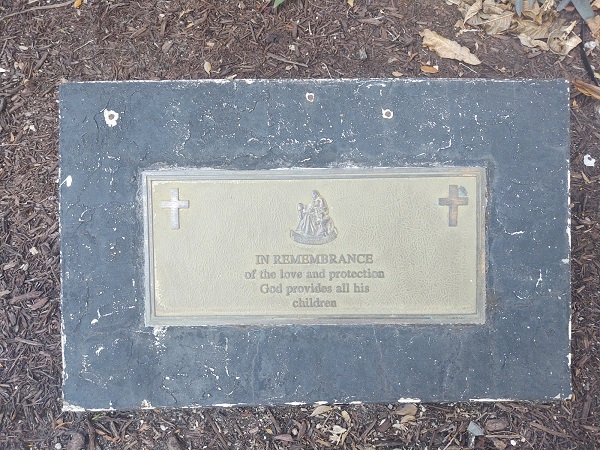
(“IN REMEMBRANCE of the love and protection God provides all his children”)
Our children may no longer be with us in this life, but it is right to honor them and their memory even as we look forward to seeing them in heaven again.
III. Hope (11-14)
And that leads us to our third point this morning, which is hope. Look at verses 11-14 with me now:
When David was told what … Rizpah … had done, 12 he went and took the bones of Saul and his son Jonathan from the citizens of Jabesh Gilead…. 13 David brought the bones of Saul and his son Jonathan from there, and the bones of those who had been killed and exposed were gathered up.
14 They buried the bones of Saul and his son Jonathan in the tomb of Saul’s father Kish, at Zela in Benjamin, and did everything the king commanded. After that, God answered prayer in behalf of the land. (2 Samuel 21:11-14)
Rizpah’s story ends on a note of hope. When David learned all that Rizpah had done for her children, he took action. He took the bones of Saul and Jonathan. He gathered the bones of those who had been killed and exposed in Gibeah. He brought them all back to the land of Benjamin where Saul’s father was buried and gave them a proper burial.
Rizpah’s actions made a difference. There was a hope and a future for her sons that she did not know at the time, but God preserved her sons’ dignity, and they were given a proper burial.
As Christians we have an even greater hope for the future. Yes, we grieve the loss of our children, but as Christians we do so in hope. Let me share with you some wise counsel from Scripture that I pray will help you in the midst of your sorrow.
A. Don’t blame God in your sorrow (or each other)
– Job 1:20-22
First of all, don’t blame God in your sorrow, or each other. Don’t blame God; rather, worship him. I think of Job in the Bible. When Job received word that he had lost all of his children all at one time, we read in Job 1: “At this, Job got up and tore his robe and shaved his head. Then he fell to the ground in worship 21 and said: ‘Naked I came from my mother’s womb, and naked I will depart. The Lord gave and the Lord has taken away; may the name of the Lord be praised.’ 22 In all this, Job did not sin by charging God with wrongdoing.” (Job 1:20-22)
Too many people push God away at the time they need him most. Too many people push their spouse away at a time when they need each other most. Don’t blame God in your sorrow, or each other.
B. Look to God for comfort, strength and peace
– 2 Corinthians 1:3-4; Psalm 73:26; John 14:27; Luke 7:13
And then secondly, look to God for comfort, strength and peace. We read in 2 Corinthians 1: “Praise be to the God and Father of our Lord Jesus Christ, the Father of compassion and the God of all comfort, 4 who comforts us in all our troubles, so that we can comfort those in any trouble with the comfort we ourselves have received from God.” (2 Corinthians 1:3-4) God longs to comfort you in your sorrow. Don’t be like Jacob who refused to be comforted. (Genesis 37:35) Let God comfort you. And then allow him to make you a channel of blessing to others in their sorrows as well.
Look to God for strength as well. We read in Psalm 73:26: “My flesh and my heart may fail, but God is the strength of my heart and my portion forever.” (Psalm 73:26) There will be times when you are not strong, when your flesh and your heart are failing. Remember God is your strength and your portion forever. He will give you his strength and get you through.
And finally, look to God for peace. Jesus said in John 14:27: “Peace I leave with you; my peace I give you. I do not give to you as the world gives. Do not let your hearts be troubled and do not be afraid.” (John 14:27) An overwhelming sorrow requires a supernatural peace. Only Jesus can give you this peace. It is a peace that does not exist in this world outside of him.
In the gospel of Luke, we read about Jesus and his disciples encountering a funeral procession. Luke tells us the person who died was the only son of his mother, and she was a widow. And then Luke tells us these beautiful words: “When the Lord saw her, his heart went out to her.” (Luke 7:13)
That’s how Jesus views you this morning. When he sees you in your sorrow and sees you grieving your loss, his heart goes out to you. It’s been said that time heals all wounds. But time doesn’t heal; God does. Look to the Lord for comfort, strength and peace.
C. Put your hope in Christ and the resurrection
– 2 Samuel 12:23; Psalm 139:15-16; 1 Thessalonians 4:13-14,17-18
And then finally, put your hope in Christ and the resurrection. Death is not the end for the Christian but only the beginning. You will see your child again.
When David lost his child, he said: “I will go to him, but he will not return to me.” (2 Samuel 12:23) David had confidence that he would see his son again in the future.
People sometimes wonder about the children we lose before birth, whether through miscarriage or abortion. We read in Psalm 139: “My frame was not hidden from you when I was made in the secret place. When I was woven together in the depths of the earth, 16 your eyes saw my unformed body. All the days ordained for me were written in your book before one of them came to be.” (Psalm 139:15-16) Every child is a precious human being created in God’s image from the moment of conception. Your child is safe in the arms of Jesus in heaven, and yes, you will see your child again.
We read in 1 Thessalonians 4: “We do not want you to be ignorant about those who fall asleep, or to grieve like the rest of men, who have no hope. 14 We believe that Jesus died and rose again and so we believe that God will bring with Jesus those who have fallen asleep in him.” (1 Thessalonians 4:13-14) This is the hope of the gospel. God will bring with Jesus all of our loved ones who have fallen asleep in him.
Paul continues in verses 17-18: “And so we will be with the Lord forever. Therefore encourage each other with these words.” (1 Thessalonians 4:17-18) God is not the God of the dead but of the living. We will see our loved ones who die in Christ again. We will be together with them and with the Lord forever. So, put your trust in God who loved the world so much that he sent his only Son, that whoever believes in him will never perish but have everlasting life. (John 3:16)
CONCLUSION: The story of Rizpah teaches us such an important truth. God offers comfort to grieving parents. You are precious to God, and your child is precious to God. Jesus’ heart goes out to you. He is the God of all comfort who comforts us in all our sorrows so we can comfort others in their troubles.
The Bible tells us death is not the end. Jesus conquered sin and death on the cross. Our little ones are safe with him. When Christ returns, the dead will be raised, and we will be reunited with our loved ones in the Lord.
I pray that as a result of this message we will all have a greater sensitivity towards parents who have lost a child. I pray that we will have a better understanding of the uniqueness of their grief. And parents, I pray that you will find comfort, strength, peace and hope in the Lord as you grieve the loss of your child in Him.
We mentioned earlier in the message how names are important to God. And so, as we close in prayer this morning, I would like to honor our lost children this morning by speaking their names in remembrance before the Lord in prayer. (Close in prayer and speak each child’s name before the Lord.)
———————
Grief Resources
Helpful Books:
The View from a Hearse – Joseph Bayly
Jonathan, You Left Too Soon – David Biebel
Seasons of Sorrow – Tim Challies
Hope in the Dark – Craig Goeschel
Through the Eyes of a Lion – Levi Lusko
Comfort for the Grieving Parent’s Heart: Hope and Healing After Losing Your Child – Gary Roe
Shattered: Surviving the Loss of a Child – Gary Roe
GriefShare:
https://www.griefshare.org/
© Ray Fowler
You are permitted and encouraged to reproduce and distribute this message provided that you do not alter the wording in any way and that you do not charge a fee beyond the cost of reproduction. For any web postings, please link to the sermon directly at this website.
Please include the following statement on any distributed copies:
By Ray Fowler. © Ray Fowler. Website: https://www.rayfowler.org
Click here for more Mother’s Day Sermons.
Click here to return to the Sermons page.
Click here for Famous Mothers in the Bible Series
Recent Discussion