


Reverse Course
Click here for more messages from the book of Acts.
Click here to return to the Sermons page.
MESSAGE SERIES: “CHURCH ON THE MOVE”
Acts 14:21-28
INTRODUCTION: Our message series is called “Church on the Move,” and we are seeing how the early church moved forward with the gospel in obedience to the command of Jesus. The past few weeks we have been traveling along with the church’s first official missionary journey, and today as we come to the close of that journey, we discover something surprising. Instead of continuing to move forward with the gospel, we see Paul and Barnabas reverse course. We see them turn around and go back the way they came. What’s up with that? (Read Acts 14:21-22 and pray.)
—————————–
When we get to Acts 14:21, Paul and Barnabas reach the end of their mission trip—or have they? They could have just continued east and gone home at this point.
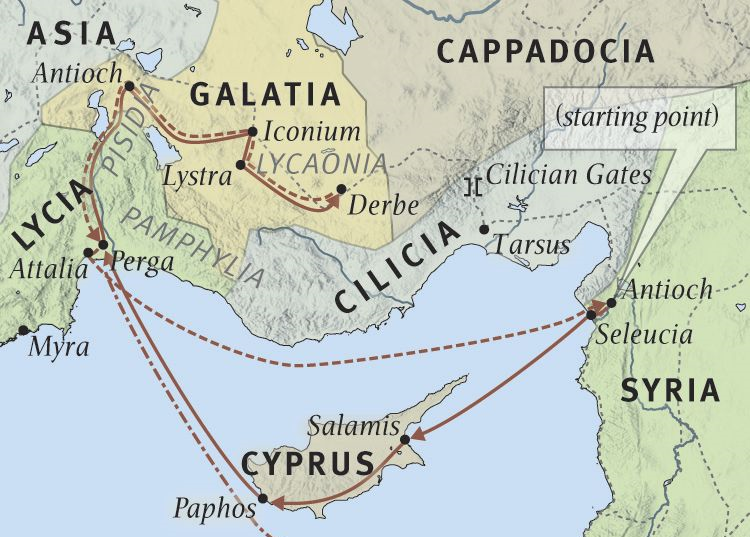
They could have traveled from Derbe to Tarsus. Tarsus was Paul’s hometown, so they could have stopped there, and then Antioch was just around the corner. Or they could have continued evangelizing new areas. Instead, they reversed course! They went back and revisited all the churches they had just established, despite all the opposition they experienced there.
Why would they do this? Because they understood the importance of follow-up. Follow-up is an essential part of making disciples. In fact, when it comes to making disciples, follow-up is just as important as evangelism.
Instead of ending their mission trip in Derbe and heading home, Paul and Barnabas retrace their steps. They revisit the believers in the cities where they previously ministered. As we follow their journey back to Antioch, we discover three vital principles related to follow-up in Christian ministry: 1) the importance of discipleship, 2) the importance of leadership, and 3) the importance of accountability.
I. Revisiting the believers: the importance of discipleship (21-22)
First, in revisiting the believers, Paul and Barnabas show us the importance of discipleship. Look at verses 21-22 with me now:
They preached the good news in that city and won a large number of disciples. Then they returned to Lystra, Iconium and Antioch, strengthening the disciples and encouraging them to remain true to the faith. “We must go through many hardships to enter the kingdom of God,” they said. (Acts 14:21-22)
They preached the gospel in Derbe and won a large number of disciples. Notice Christians are called disciples of Jesus from the moment they first believe. A disciple is simply someone who is following Jesus, and the first step in following Jesus is believing in him.
By the way, this is the first time on this trip we don’t hear of any opposition to the gospel. We are simply told they preached the good news of Jesus, and they won many disciples. That doesn’t mean there wasn’t any opposition, but it’s interesting that it is not mentioned or highlighted as it has been in each of the previous cities.
A. Retracing their steps (21)
But now Paul and Barnabas do something unexpected. Instead of continuing their missionary journey or heading straight back to Antioch, they retrace their steps and revisit the cities they have already visited—places where they did experience opposition and persecution. They reverse course, and they go back to Lystra, Iconium and Antioch, where they had already preached the gospel.
What’s amazing here is that they had been traveling in a loop, which means they were almost home if they just continued forward. But by reversing course, they were actually heading away from home instead of towards it. They were going in the opposite direction. They were taking the long way home.
B. Strengthening the disciples (22)
Why would they do this? Because of the importance of discipleship. Missions is not just about evangelism but also discipleship. Just because they had already won disciples in the previous cities doesn’t mean those new disciples didn’t need to be discipled.
It sounds funny, but all disciples need to be discipled. That’s the way it works. Are you a believer in Jesus? Then you are a disciple of Jesus, and you also need to be discipled.
Wasn’t it important for other people to hear about Jesus, too? Of course. But it was also important that these new believers be established in their faith. And so, Paul and Barnabas go back to each of the cities, strengthening the disciples and encouraging them to remain true to the faith.
What does it mean to be true to the faith? “The faith” here is a code word for doctrine or the core teaching that every Christian should know. At other times in Scripture, it is also called the tradition, the deposit, teaching or truth. This core teaching would have included the gospel, as well as teaching about God, Jesus, the Holy Spirit, the Scriptures and the church—basically all the types of things we find Paul writing about in his letters. These letters from Paul, by the way, were read in the churches along with the Old Testament Scriptures as the very word of God.
Paul and Barnabas had encountered opposition in these cities, and that means the new believers were also experiencing opposition. Paul and Barnabas reminded them that hardships for believers were normal. They told them, “We must go through many hardships to enter the kingdom of God.” It’s like the words of the old song: “If you don’t bear the cross, then you can’t wear the crown.” As believers we must go through many hardships to enter the kingdom of God.
Think about it. Why do some would-be disciples turn back? Because it’s hard! It’s hard to follow Jesus. That was one of the points Jesus made in the parable of the soils: “The one who received the seed that fell on rocky places is the man who hears the word and at once receives it with joy. But since he has no root, he lasts only a short time. When trouble or persecution comes because of the word, he quickly falls away” (Matt. 13:20-21). Paul and Barnabas came back to make sure these new believers had deep roots, so they would not fall away because of persecution.
So that’s the first reason Paul and Barnabas reversed course and followed up with the new believers—because of the importance of discipleship.
II. Appointing elders: the importance of leadership (23-25)
They not only went back to strengthen the disciples in each of these cities. They also appointed elders for them. So, now we turn from the importance of discipleship to the importance of leadership.
Church elders in the New Testament are the same as pastors. They are those leaders whom God calls to shepherd the church. The qualifications for elders are listed in 1 Timothy 3:1-7 and Titus 1:5-9.
There was usually a team of pastors or elders in the New Testament churches, and it is good to have a team of pastors or elders in churches today. I thank God for my fellow elders and pastors in this church who help share the load, as we encourage each other, sharpen each other and lovingly lead this church together in Christ.
A. Prayerful, careful selection of leaders (23)
– 1 Timothy 3:1-7; Titus 1:5-9
Look at their prayerful, careful selection of leaders with me now in verse 23:
Paul and Barnabas appointed elders for them in each church and, with prayer and fasting, committed them to the Lord, in whom they had put their trust. (Acts 14:23)
Normally we find churches selecting their own pastors or elders, but here Paul and Barnabas did it for them, probably because these were young congregations and they needed Paul and Barnabas’ help in selecting the right men for the job.
Notice they did this in each church, not in just some of the churches. Every church needs called, qualified, biblical leadership. Notice they did this with prayer and fasting as they committed them to the Lord. This shows a prayerful, careful selection of leaders for the church. This is similar to ordination today, which is also a careful, prayerful process. Notice also they committed these leaders to the Lord—not to the church or governing board, but to the Lord who had called them into ministry.
Notice finally that the Lord is described as “[him] in whom they had put their trust.” What’s the number one qualification for a pastor? Trust in God rather than self! You have to put God first, and your trust has to be in him.
When I candidated for the position of pastor at this church back in 2012, my candidating message was titled: “I Can’t Do This!” Probably not the best way to inspire confidence in the congregation that is praying about calling you as pastor. But fortunately, there was a second part to the message. “I can’t do this—but God can.” That’s the message we hold to even today.
It’s not enough to evangelize; we must also disciple. And it’s not enough to personally disciple; we need leaders in churches who can continue the process when we are gone. Paul and Barnabas appointed elders for them in each church and, with prayer and fasting, committed them to the Lord, in whom they had put their trust.
B. Additional preaching (24-25)
And then after stopping in each of these cities to disciple the believers and appoint elders for the churches, Paul and Barnabas continued on their way back to Antioch, stopping and doing further evangelism along the way. Look at verses 24-25:
After going through Pisidia, they came into Pamphylia, and when they had preached the word in Perga, they went down to Attalia. (Acts 14:24-25)
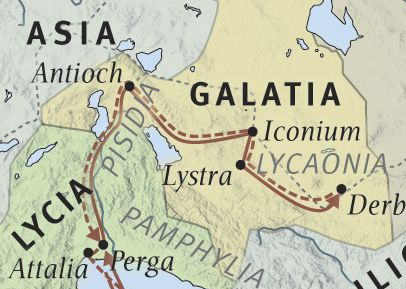
As Paul and Barnabas continued retracing their steps, they stopped to do some evangelizing in Perga and then returned to the port at Attalia where they set sail for Antioch.
These are the two pillars of mission work: evangelism and discipleship. In evangelism, we make disciples of Jesus. In discipleship, we strengthen disciples of Jesus. In appointing elders, we ensure the ministry of discipleship continues long after we are gone.
III. Reporting back: the importance of accountability (26-28)
We have looked at the importance of discipleship as Paul and Barnabas retraced their steps. We have looked at the importance of leadership as they appointed elders in each church. Finally, let’s look at the importance of accountability as they report back to the church in Antioch. Look at verses 26-28 with me now:
From Attalia they sailed back to Antioch, where they had been committed to the grace of God for the work they had now completed. On arriving there, they gathered the church together and reported all that God had done through them and how he had opened the door of faith to the Gentiles. And they stayed there a long time with the disciples. (Acts 14:26-28)
A. Back to their sending church (26)
It’s been a long, hard journey, but they finally return to their sending church at Antioch. Notice they sail straight from Attalia to Antioch. They skip Cyprus, which was their first stop on the mission trip, most likely because although they shared the gospel, they had not established a church there.
I like the way Luke describes the church at Antioch. This is where “they had been committed to the grace of God for the work they had now completed.” The church at Antioch had committed Paul and Barnabas to the Lord with prayer and fasting, just as Paul and Barnabas did with the elders in each church during their reverse course.
Notice their work was not completed until they went back to the cities they had previously evangelized to strengthen the disciples and appoint elders. This was not additional work for them. This was part of the work to which they had been called.
The first missionary journey was now complete. We’re not told how they knew their job was done, but they completed the work they set out to do, and then they returned home.
B. Full report of all that God had done through them (27-28)
When they got back to Antioch, they called the whole church together and gave them a full report. Even this reporting is part of the work, for we are accountable to those who send and support us in ministry.
First, they told them all that God had done through them. Notice how they give God the glory in everything. They were committed to the work by God’s grace, and it was by God’s grace they completed the work, not by their own efforts. John Stott writes: “The grace had come from him; the glory must go to him.”
They didn’t just give a partial report. They told everything. They didn’t want to leave anything out. God was doing great things, and they wanted the church to hear it all.
Secondly, they especially told how God opened the door of faith to the Gentiles. Notice it is God who opens the door of faith. We share the gospel, but God opens the door. The big detail here is that God had done this for the Gentiles. The gospel was going forth to the world, just as Jesus had commanded.
Paul and Barnabas had been gone for two years. How would you like to sign up for a two-year mission trip? I’ve gone on some two-week mission trips, and I am really glad to get home after two weeks. Imagine being gone for two years. They successfully shared the gospel, planted churches, discipled new believers, and appointed leadership in the churches, especially in the region of Galatia.
Luke closes out the chapter by telling us Paul and Barnabas stayed in Antioch a long time. It’s a good thing they did, because some troublemakers were about to arrive from Judea. (More on that next time.)
CONCLUSION: The applications from today’s message are simple and drawn straight from the text.
First up is the importance of discipleship. It’s not enough to win people to Christ. We must establish them in their faith. That is part of follow-up, following up with people. When you witness to someone, don’t just leave them there. Follow up with them.
I met someone who instead of business cards carries around what he calls “friend cards.” Each card has his name on the top and instead of stating what business he does, it simply says “A Friend.” He then lists his cell number, his email address and the website of his church. The card then states: “Call, email or text if you need solutions to life’s problems, how to know God or how to have eternal life.” Every person he witnesses to, he gives them a card. Why? So he can follow up with them. If you share the gospel with someone and just walk away, there’s no opportunity to follow up later. This way people can get in touch if they have further needs or questions.
Secondly, there is the importance of leadership. It’s not enough to plant churches. We must ensure there is qualified leadership in each church. This also applies to when you are either looking for a church or recommending a church for someone else. Make sure the church you attend or recommend has biblically qualified leadership.
And then finally there is the importance of accountability. It’s not enough to do missions or ministry. We must be accountable to those who send and support.
These are important principles for a church on the move. Sometimes we can be so focused on moving forward that we forget about those we have already reached. That’s where follow-up is so important. New believers are spiritual babies in Christ; they are sitting ducks for the enemy. When we first come to Christ, we need to be taught, encouraged and strengthened in the faith.
This will actually increase evangelism in the long run. You can only share Christ personally with so many people yourself. But when you disciple someone who has come to Christ, they will share their faith with others. And when they disciple those new people who have come to Christ, the new believers will share their faith also.
Follow-up is an essential part of making disciples. We need to follow up with believers by discipling them. We need to follow up with churches by making sure they have qualified leaders. We need to follow up with our supporters by sharing with them all that God is doing through us.
Sometimes the way forward is back. Don’t just share your faith with people and move on. Reverse course. Go back and disciple them. Follow up with those who have made a faith commitment to Jesus Christ. Make sure that new believers are attending biblically-based churches with qualified leaders. Report back to others and share all the good things God is doing.
Yes, we are called to be a church on the move, but as we move forward with the gospel, let’s also be careful that we don’t leave anyone behind.
© Ray Fowler
You are permitted and encouraged to reproduce and distribute this message provided that you do not alter the wording in any way and that you do not charge a fee beyond the cost of reproduction. For any web postings, please link to the sermon directly at this website.
Please include the following statement on any distributed copies:
By Ray Fowler. © Ray Fowler. Website: https://www.rayfowler.org
Click here for more messages from the book of Acts.
Click here to return to the Sermons page.
Recent Discussion