


God’s Guidance
Click here for more messages from the book of Acts.
Click here to return to the Sermons page.
MESSAGE SERIES: “CHURCH ON THE MOVE”
Acts 16:6–10
INTRODUCTION: Our message series is called Church on the Move, and we just got started on Paul’s second missionary journey. As we learned last week, Paul’s initial plan was simply to revisit the churches he had planted on the first trip. But before the trip is over, he will go to Europe and start planting churches there as well. So how did Paul end up going from Asia to Europe? The same way you and I get to where we’re supposed to be going — by learning to recognize and follow God’s guidance in our lives. (Read Acts 16:6–10 and pray.)
——————————————-
One of the most common questions we have is, “What is God’s will for my life?” Sometimes we ask it as a big question: “What is God’s overall will for my life?” Sometimes we ask it for smaller things: “What does God want me to do next? What does God want me to do right now?” It’s a good question because it shows you are seeking God first in your life and seeking to do his will rather than your own.
So how do you know God’s will for your life? How do you know what his next steps are for you? There’s a lot involved in the answer to that question, as we will see in studying today’s passage.
It’s also important to understand that God’s will often embraces a range of options for you as a believer. We don’t want to walk around paralyzed with fear that we might somehow miss God’s will and mess up the rest of our lives. God is bigger than that, and many times his will involves how you respond to various aspects of life rather than that you choose one specific option over another.
The bottom line is you can trust God to guide you when you are truly seeking his will for your life. And that’s what our passage is about today — learning to discern, trust, and follow God’s guidance in your life.
I. Phrygia and Galatia (6)
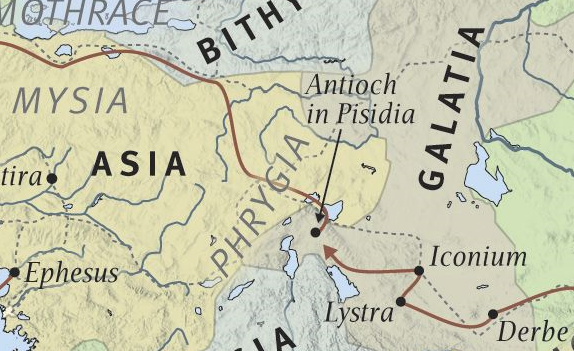
Our passage begins with the next phase of this missionary journey, which takes Paul through the region of Phrygia and Galatia. Look at verse 6 with me now:
Paul and his companions traveled throughout the region of Phrygia and Galatia, having been kept by the Holy Spirit from preaching the word in the province of Asia. (Acts 16:6)
Phrygia and Galatia are northwest of the areas Paul visited on his first missionary journey. He is still in modern-day Turkey, but he is now venturing into new ground.
A. Team ministry (6a)
There are a couple things we want to emphasize in this section concerning missions and God’s guidance in your life. The first is the importance of team ministry. Luke makes reference to Paul and his companions. We saw last week how Paul and Silas set out on this second missionary journey together, adding Timothy to the team along the way.
Team ministry is important for so many reasons: sharing the work, encouraging each other, accountability to each other, and more. But it is also important for discerning God’s will. God promises to give us wisdom when we ask (James 1:5), and one of the ways God speaks to us is through other people.
Proverbs 15:22 tells us: “Plans fail for lack of counsel, but with many advisers they succeed.” With many counselors comes wisdom. When you are part of a team, you can talk and pray through God’s will together and seek a unified vision of what God is calling you to do next.
B. Led by the Holy Spirit (6b)
We also see a clear example here of Paul and his companions being led by the Holy Spirit. As they continued their journey, Luke tells us they were kept by the Holy Spirit from preaching the word in Asia.
Asia is where the cities of Ephesus and Colosse are located. They tried to turn west to get to these cities, but the Holy Spirit prevented them.
It’s an unusual comment, which leaves us wanting more information. How did the Holy Spirit prevent them? We’re not told exactly. Perhaps this was an act of providence, whether through illness or opposition. Perhaps they were given a direct prophecy concerning this. Silas was introduced as a prophet back in chapter 15 (v. 32). This could also be as simple as seeking God’s will together in prayer. There’s that team ministry aspect again. When you come to a unity in prayer together, you can have confidence that the Holy Spirit is guiding and leading you in the right direction.
Another question is why the Holy Spirit prevented them. It sounds so strange: “The Holy Spirit kept us from preaching God’s word.” Why would the Holy Spirit do that? We don’t know at this point in the story, but we will soon find out. Paul will get to the Ephesians and the Colossians soon enough, but for right now, the Holy Spirit has other plans for him. You can’t be in two places at the same time, and God’s plan was for the gospel to go to Europe next.
This is another important principle when you’re seeking God’s guidance in life: Don’t forget the Holy Spirit. The Holy Spirit is called our Counselor in Scripture (John 14:26). The Holy Spirit is active in guiding and directing you when you seek God’s will.
II. Troas (7–8)
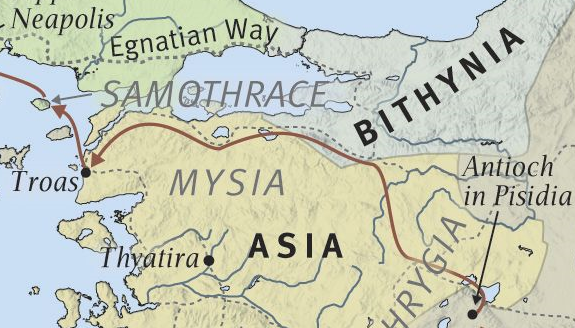
The next part of the journey takes them to Troas. Troas was a port city in the northwest corner of modern-day Turkey, located on the east side of the Aegean Sea and about 200 miles north of the Mediterranean Sea. This was a 360-mile segment of the journey for Paul and his companions that would have taken a good fifteen days of walking. But once again, the most interesting part of the story is how they got there.
A. More closed doors (7)
It begins with more closed doors for the gospel. Look at verse 7 next:
When they came to the border of Mysia, they tried to enter Bithynia, but the Spirit of Jesus would not allow them to. (Acts 16:7)
When they came to the border of Mysia and tried to enter Bithynia, the Spirit stopped them again. This was the northwest border of modern-day Turkey, with Mysia to their left and Bithynia to their right. They tried to head northeast up towards Bithynia by the Black Sea, but the Spirit of Jesus would not allow them to do so.
So here we have the same situation as in verse 6. God is leading them in a certain direction. First they tried to turn left, and the Holy Spirit stopped them. Then they tried to turn right, and the Spirit stopped them again. Well, if you can’t turn left, and you can’t turn right, and you’re not turning around to go back the way you came, what’s left? Straight ahead! And so the Spirit keeps guiding them on toward Europe.
Just a note here — the Spirit of Jesus and the Holy Spirit both refer to the third person of the Trinity. They are just different ways the Bible speaks about the Holy Spirit. But the phrase “the Spirit of Jesus” brings out a very important point here.
Do you remember our long title for the book of Acts from our very first message in the series? The book of Acts is often called “the Acts of the Apostles” because the apostles play a big part in the early days of the church. Others say it should be called “the Acts of the Holy Spirit” because it is really a record of the Holy Spirit working in and through the apostles. But I think we should take it a step further and call it “the Acts of Jesus through the Holy Spirit working in the apostles,” because this is a record of what Jesus is continuing to do through the church as empowered by the Holy Spirit. Calling the Holy Spirit “the Spirit of Jesus” here is a good reminder that this book is all about what Jesus is doing through the Spirit working in the apostles.
Paul and his team must have been very perplexed as to why God wasn’t letting them go and preach the gospel in these places, but God often closes various doors as you prayerfully seek your next steps. It can be frustrating, but we should really be grateful, because God is simply keeping you from walking through the wrong door.
B. Continuing on mission (8)
So what do you do when God closes various doors for you? Do you get mad at God? Do you get discouraged? Do you take your ball and go home? Paul and his companions continued on mission. Look at verse 8 with me now:
So they passed by Mysia and went down to Troas. (Acts 16:8)
If God didn’t want them to go to Asia, and God wouldn’t let them enter Bithynia, then that meant God wanted them somewhere else. They still didn’t know exactly where God was calling them to go, but they knew what God had called them to do. So they continued on to Troas and shared the word of God there instead.
III. Macedonia (9–10)
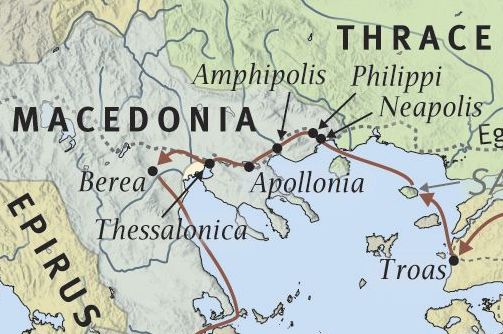
And that brings us to Macedonia. Once again, Troas was a port city in the northwest corner of modern-day Turkey sitting directly across the sea from Greece and Macedonia. God has been steering them in this direction for a purpose, and now we are about to find out that purpose.
A. Vision in the night (9)
While they are in Troas, Paul has a vision in the night. Look at verse 9 next:
During the night Paul had a vision of a man of Macedonia standing and begging him, “Come over to Macedonia and help us.” (Acts 16:9)
This vision took place during the night, so it may have been a vision within a dream. But either way Paul has this vision of a man from Macedonia begging them to come over to help them.
God doesn’t always speak to us through dreams, and we need to be careful about how we interpret dreams (more on that later), but God has no shortage of ways to show you the right door when the right time comes.
God had used a variety of means to get them to Troas, but now that they were closer to the goal, he gave them more specific guidance on where to go next. Instead of closing more doors, God gave them a glimpse through the door he had planned for them all along.
God has no shortage of ways to communicate his will to you, but here’s the thing. You’ll know when you need to know, and you’ll know when it’s best for you to know. Sometimes God leads by closed doors, sometimes he leads by open doors, but either way, you need to commit all your ways to him in prayer and trust his leading.
B. Following where God leads (10)
– Psalm 23:3; Proverbs 3:5–6
And that’s where following God’s leading comes in. There’s not much sense in seeking God’s leading if you’re not going to follow it. In this case, Paul was confident this was God’s direction for them, and they immediately followed. Look at verse 10 now:
After Paul had seen the vision, we got ready at once to leave for Macedonia, concluding that God had called us to preach the gospel to them. (Acts 16:10)
They still didn’t know all that God had planned for them, but they immediately got ready to leave for Macedonia.
The safest way to know God’s will for your future is to be faithful in following God’s revealed will in the present. Proverbs 3:5–6 tells us: “Trust in the Lord with all your heart and lean not on your own understanding. In all your ways acknowledge him, and he will make your paths straight.”
Notice the phrase “God had called.” In verse 6 it was the Holy Spirit who led them. In verse 7 it was the Spirit of Jesus. Now here in verse 10 it is God who leads them. Father, Son and Holy Spirit were all involved in guiding them to this next step in their journey. What had God called them to do? To preach the gospel in Macedonia, to bridge the gospel from Asia to Europe, to continue sharing the gospel with new people in new lands.
Notice also that the narrative changes from third person plural to first person plural in this verse. Luke no longer writes about what they did or where they went but what we did and where we went. It’s a subtle difference, but the reason is clear. Dr. Luke has joined the team! They met up with Luke in Toas, and Luke is now a first-person witness of all that happens next.
What’s truly amazing about all this is they have no idea what God is going to do through this next step. We know because we know history, but they had no idea. Because they were obedient in taking this next step, the gospel would eventually spread throughout all of Europe, bringing salvation to millions and changing western civilization. Christianity would directly impact art, literature, music, science, education, health and politics. Europe would become the first Christian continent and send out missionaries to all the other continents, including the Americas.
When they finish this second missionary journey, Paul will have planted churches in three new Roman provinces. That’s it. Paul had no idea (although the Holy Spirit did) that this was all part of God’s plan for bringing the gospel to the whole world.
CONCLUSION: So, we’ve talked a lot about how God guided Paul and his companions on this second missionary journey. Now let’s take those same principles and apply them to ourselves. How can we learn to discern, trust and follow God’s guidance in our own lives today? Let me share with you four principles relating to God’s guidance in closing.
1) Open and closed doors: The first principle has to do with open and closed doors. Paul and Silas tried to enter Asia and God stopped them. Then they tried to enter Bithynia and God stopped them again. Finally, God opened the door for them to Europe.
We often get frustrated by closed doors, but we need to remember that God is sovereign and he can open any door any time he wants. There will always be more closed doors than open doors when you are seeking God’s will, because God is leading you toward the right door he has for you. In fact, God often uses the closed doors to guide you to the open door.
2) Dreams: The second principle has to do with dreams. God finally led Paul and his companions to Europe through a vision given in the middle of the night. We often wonder about dreams. We know God spoke to people through dreams in the Bible, but does he still do that today?
God can still speak this way when he chooses to, but you need to be careful with dreams, as they are not always a reliable guide. Yes, it could be God, but it could also just be a bad ham sandwich. When you think God may have spoken to you through a dream, always test it with prayer, the word of God, and counsel from others.
3) Faith: The third principle has to do with faith. After Paul saw the vision, Luke tells us: “We got ready at once to leave for Macedonia, concluding that God had called us to preach the gospel to them” (Acts 16:10). Notice they still didn’t know for sure. It was just a vision of a man from Macedonia calling out for help. They still had to take a step of faith.
It’s the same with us. We don’t always know for sure what God’s next step is for us either. But if you’ve prayed about it and sought godly counsel and God has opened the door, sometimes your next step is the step of faith. You need to take a step of faith and walk through the door God has opened for you in answer to prayer.
4) Obedience: That leads us to our fourth principle which has to do with obedience. At first Paul and Silas weren’t sure where God was leading them. God was closing doors on them left and right. But they knew God wanted them to preach his word, so they kept doing that. They were obedient to what they knew God had called them to do.
We need to do the same. As you seek God’s guidance in your life, be sure to obey God’s revealed will wherever you are. God has given us plenty of commands in the Bible — love God; love one another; be kind to each other; forgive each other; practice holiness; help those in need. There’s plenty of God’s will to obey while you’re waiting for the next step to be revealed.
You can trust God to guide you when you are truly seeking his will for your life. God has promised to give you wisdom when you ask. He has given you his word, his Holy Spirit and the wisdom of others to help guide you. He will open and close various doors as needed. He has promised to direct your paths when you trust and obey.
We should all want to know God’s will, because God’s plans for us are always best, and we should always be seeking his kingdom and righteousness first in our lives. I pray as a result of this message you will have a clearer understanding of how God guides us in life. I trust you will learn to pray for God’s will, seek God’s will, trust God’s guidance, and step out in faith to follow where God leads.
© Ray Fowler
You are permitted and encouraged to reproduce and distribute this message provided that you do not alter the wording in any way and that you do not charge a fee beyond the cost of reproduction. For any web postings, please link to the sermon directly at this website.
Please include the following statement on any distributed copies:
By Ray Fowler. © Ray Fowler. Website: https://www.rayfowler.org
Click here for more messages from the book of Acts.
Click here to return to the Sermons page.
Recent Discussion