


His Name is Mighty God
Click here for more messages from the Names Above All Names series.
Click here for more Christmas messages.
Click here to return to the Sermons page.

Note: This sermon series is now available in book form. Click the image to view on Amazon.
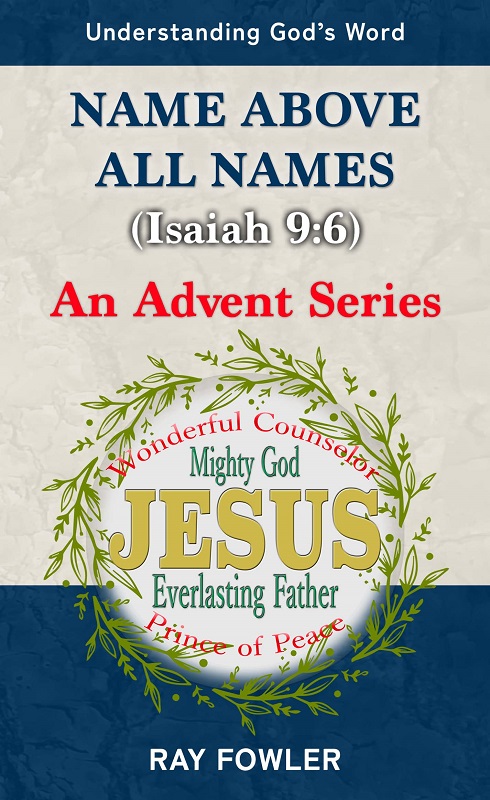
Note: The book contains additional bonus material with selected commentary, poems and songs on Isaiah 9:6 through the ages.
Click here for more books in the Understanding God’s Word series.
—————–
(Isaiah 9:6)
INTRODUCTION: Our Advent Series is called Name Above All Names, and we are looking at the names of Jesus as revealed by the prophet Isaiah in Isaiah 9:6. Isaiah prophesied the birth of a baby boy who would be recognized by these four remarkable names. And as we said last week, these are not names in the sense of the names that we call each other by every day. Rather these are names that speak of the character, the nature, the very essence of this child who would be born. Last week we looked at the first name, “Wonderful Counselor,” and this week we will look at the second name, “Mighty God.” (Read Isaiah 9:6 and pray.)
————————————————
Most people like Christmas, and as far as I know, all people love babies. So, you would think that everyone would love the Nativity Scenes we display at Christmas. Unfortunately, this is not so, and every year we see Nativity Scenes being attacked, litigated, and taken down by various government officials across the nation.
A famous example took place a number of years ago in California where for sixty years the city of Santa Monica had hosted a number of spectacular Nativity Displays in Palisades Park. But after a series of objections, the city put an end to the tradition and banned any further displays in the park. Now, the wording of the ban only specified non-manned displays, so a number of churches found a creative way around the ban by doing live nativity scenes instead. They would dress up like shepherds and wisemen and other historical figures presenting Jesus’ birth and take to the park every night, singing carols and telling the Nativity story. But the traditional displays were relegated to church properties instead of the park.
But you have to wonder, if most people like Christmas and all people love babies, what is wrong with the Nativity Scene that people fight against it so fiercely? What could possibly be offensive about a baby in a manger? I would submit to you the answer is found in this second name Isaiah gives to Jesus here in 9:6 – “And he will be called Wonderful Counselor, Mighty God.” No one is offended simply by a baby in a manger. But when the baby in the manger is called “Mighty God,” watch out! And that’s where all the controversy lies.
Today’s message is very simple. I want us first of all to consider that the baby in the manger is fully God. That’s the “God” part of the name Mighty God. And then I want us to see that Jesus does things that only God can do. That’s the “mighty” part of the name Mighty God.
I. The baby in the manger is fully God
– Philippians 2:6-7
So, first of all, the baby in the manger is fully God. Let us tread slowly here for we are on holy ground. This is the heart of the mystery and wonder of Christmas. It would be amazing enough if God just suddenly appeared to us as a man in human form, but that he would be born into our world as a tiny baby is beyond understanding – which as you might remember from last week is what the word “Wonderful” means in the first name “Wonderful Counselor.” It means “astonishing, amazing, beyond understanding, something only God can do.”
Some people try to soften Isaiah’s meaning by pointing to verses in the Bible where kings were sometimes called “gods” in the sense of being rulers without meaning they were actually divine. But the particular word Isaiah uses for God in this name is the Hebrew word “El.” You might recognize it as the ending of the familiar Christmas word “Immanuel,” which means “God with us.” And the word “El” is used only for the one true God and for him alone.
For example, in Hosea 11:9 where God says, “For I am God, and not man,” the word “El” is used specifically to draw a contrast between God and man. And in Isaiah 10:21, the very next chapter of Isaiah, the phrase “Mighty God” refers specifically to Yahweh himself: “A remnant will return, a remnant of Jacob will return to the Mighty God.” (Isaiah 10:21) There is no doubt about it. When Isaiah calls this baby “Mighty God,” he is saying that he is Yahweh, he is the Lord Almighty. The baby in the manger is fully God.
The theological word we use to describe God becoming human is “incarnation.” It comes from the Latin and literally means “becoming in flesh.” And if we do not take time to reflect on the incarnation, on what it means that the baby in the manger is God who has come in the flesh, then we miss the central part of Christmas. We will never fully understand the incarnation (remember, it is “beyond understanding”), but as we reflect on it biblically, we will be drawn to worship our Mighty God who loved us so much that he was born into our world as a baby.
Philippians 2:6-7 is one of the most important Scriptures for understanding what the incarnation means and what it does not. Let’s look at these two verses together:
“Christ Jesus, who, being in very nature God, did not consider equality with God something to be grasped, but made himself nothing, taking the very nature of a servant, being made in human likeness.” (Philippians 2:6-7)
There are two truths in particular I want you to see from these verses. Jesus did not cease being God when he became human. Rather, he gave up his rights as God in becoming human.
A. He did not cease being God when he became human
First of all, Jesus did not cease being God when he became human. Philippians 2:6 says that Jesus is “in very nature God.” Jesus did not set aside his divine nature when he became human. He assumed a human nature, but he never ceased being God. He was fully God and fully man.
One of the most important meetings of the early church took place in modern day Turkey from October 8 to November 1 in the year A.D. 451. We call it the Council of Chalcedon, and it was convened specifically to address this issue of the incarnation as revealed in Scripture. Although the church already understood from the Scriptures that Jesus was God, there was still confusion as to how Jesus could be both human and divine at the same time. Was Jesus part human and part God? Was he two different persons – a divine person and a human person all wrapped up in one?
The church leaders at Chalcedon studied these issues and came up with a Scriptural solution that has been accepted by all three major branches of Christianity – namely that Jesus Christ is one divine person with two natures, and that these two natures “remain distinct, whole, and unchanged, without mixture or confusion so that the one person, Jesus Christ, is truly God and truly man.” (Chalcedonian Definition)
That’s a whole lot of theology so let me summarize it for you in this way: “Jesus Christ is one person with two separate natures. As long as you don’t divide him into two people, or confuse his two natures, you’re doing fine.”
The incarnation is not “God minus something” but “God plus something.” It is not God the Son minus his divine nature, but rather God the divine Son plus his human nature. St. Augustine put it this way: “He took to himself what he was not, while remaining what he was; … he continued to be what he is, while appearing to us as what we are.” (Augustine of Hippo; Sermon, A.D. 396)
Jesus is fully God and fully man. As Philippians 2 says, he is in very nature God. He did not cease being God when he became human.
B. Rather, he gave up his rights as God in becoming human
But even though he did not cease being God, Jesus did lose something else when he became man. So, let’s take a look at those two verses in Philippians again:
Who, being in very nature God, did not consider equality with God something to be grasped, but made himself nothing, taking the very nature of a servant, being made in human likeness.” (Philippians 2:6-7)
What the rest of this verse is saying is this: Jesus did not cease being God when he became human. Rather, he gave up his rights as God in becoming human.
Jesus had certain rights as God. He had the right to be manifest in his full glory at all times. He had the right to be worshiped and served in heaven by countless angels and other created beings. He had the right to exercise his divine attributes of omniscience (knowing all things), omnipotence (having power over all things), and omnipresence (being present everywhere at all times). He had the right not to suffer hunger or thirst or tiredness or pain as humans do. And he certainly had the right not to die as he was perfect and sinless in every way.
Jesus did not cease being God when he became human, but he gave up all these rights as God when he became human. And he did this so that he could live a perfect, sinless life and then die on the cross in our place to save us from our sins.
What I want us to see this morning from Isaiah 9:6 is that Jesus was fully God and fully man even as the baby in the manger. He did not grow to become God. No one can become God; not even God can become God, because one of the primary characteristics of God is that he has always been God. He did not become God at some point in time; he has always been God and always will be. And so, the baby in the manger is fully God. And as with the wise men of old, the only proper response is to draw near in wonder to worship and adore him.
II. Jesus does things that only God can do
I mentioned earlier there are two things I want us to consider today in relation to this name “Mighty God.” The first is that the baby in the manger is fully God. We have done that. Now I want us to consider the second item: Jesus does things that only God can do. And that’s because the focus in this second name is on his power. Jesus is not only God – Isaiah calls him “Mighty God.”
The word translated “mighty” is the Hebrew word for “hero, champion or warrior.” We love our superheroes, don’t we? The Greeks celebrated the exploits of Hercules. Today we have Iron Man, Aqua Man and the Avengers. And it seems we just can’t get enough of these super-human beings who do amazing things.
Well Isaiah says that the child to be born will be both a “wonder counselor” and a “hero God” – the God of power and might who does amazing things for his people. And that is exactly what we see when we come to Jesus in the New Testament. He is Mighty God! Why? Because he does things that only God can do. Let us look at four of those things briefly.
A. The power to create: All things were made through him
– John 1:3; Colossians 1:16
First of all, Jesus has the power to create. We know from the Bible that only God has the power to create. In fact, the very first words in the Bible are: “In the beginning God created the heavens and the earth.” (Genesis 1:1) Only God creates.
And yet when we step into the pages of the New Testament, we find that Jesus also has the power to create. We read in John 1:3: “Through him all things were made; without him nothing was made that has been made.” (John 1:3) Or in Colossians 1:16: “For by him all things were created: things in heaven and on earth, visible and invisible, whether thrones or powers or rulers or authorities; all things were created by him and for him.” (Colossians 1:16)
If only God can create, and yet all things were made through Jesus so that without him nothing was made that has been made, what does that tell us about Jesus? It tells us that he is Mighty God because he has the power to create.
B. The power to save: He forgives sin
– Isaiah 45:22; Mark 2:9-11; Acts 4:12
Secondly, Jesus has the power to save. In the gospel of Mark we read about the four men who brought their paralyzed friend to Jesus for healing, lowering him on his mat through the roof. When Jesus saw their faith, he said to the paralytic, “Son, your sins are forgiven.” Now some teachers of the law were sitting there, thinking to themselves, “Why does this fellow talk like that? He’s blaspheming! Who can forgive sins but God alone?” Immediately Jesus knew in his spirit that this was what they were thinking in their hearts, and he said to them, “Why are you thinking these things?”
“Which is easier: to say to the paralytic, ‘Your sins are forgiven,’ or to say, ‘Get up, take your mat and walk’? But that you may know that the Son of Man has authority on earth to forgive sins…” He said to the paralytic, “I tell you, get up, take your mat and go home.” (Mark 2:9-11)
And the man got up, took his mat and walked out in full view of them all. What was Jesus doing here? He was showing through this healing that he has the power to forgive sins. He has the power to save.
Once again, only God has the power to save. God says in Isaiah 45:22: “Turn to me and be saved, all you ends of the earth; for I am God, and there is no other.” (Isaiah 45:22) Only God can save, and yet we read in Acts 4:12 about Jesus: “Salvation is found in no one else, for there is no other name under heaven given to men by which we must be saved.” (Acts 4:12) Jesus is Mighty God because he does things that only God can do. He has the power to create, and he has the power to save.
C. The power to resurrect: He conquered sin and death
– Romans 1:3-4; John 5:21, 11:25-26
Thirdly, Jesus has the power to resurrect. Romans 1 says this about Jesus: “…who as to his human nature was a descendant of David, and who through the Spirit of holiness was declared with power to be the Son of God by his resurrection from the dead: Jesus Christ our Lord.” (Romans 1:3-4)
In the movies every superhero needs someone or something big to conquer. In fact, moviemakers put as much thought into the villain as they do the hero, because without a really good villain, the superhero doesn’t seem so super. Well, Jesus came into the world to conquer the biggest, baddest enemies of all – sin, death and the devil. And in conquering sin and death, Jesus showed that he has the power of resurrection.
Once again, this is something only God can do. Only God has the power over life and death. And yet Jesus says in John 5: “For just as the Father raises the dead and gives them life, even so the Son gives life to whom he is pleased to give it.” (John 5:21) Jesus says in John 11: “I am the resurrection and the life. He who believes in me will live, even though he dies; and whoever lives and believes in me will never die.” (John 11:25-26) So, that’s a third reason Jesus is Mighty God – because he has the power to resurrect.
D. The power to judge: He will judge the living and the dead
– John 5:22-23
And then finally, Jesus has the power to judge. Jesus says in John 5: “Moreover, the Father judges no one, but has entrusted all judgment to the Son, that all may honor the Son just as they honor the Father.” (John 5:22-23)
We know from the Old Testament that God is the judge of all the earth. (Genesis 18:25) And yet here in the New Testament we learn that Jesus has all the power to judge. He will return from heaven to judge the living and the dead.
Jesus has the power to create, the power to save, the power to resurrect and the power to judge. These are things that only God can do, and yet Jesus does them too! It’s no wonder Isaiah called the baby in the manger “Mighty God.”
CONCLUSION: In conclusion, if Jesus is Mighty God, there are three clear implications for all of us here this morning:
1) You must submit to him as Lord. He is the creator – you owe him your life. He is the savior – he gives you new life. He is the resurrection – he gives you eternal life. He is the judge – he will evaluate your life. Your whole life is in his hands. When Mary first held the newborn Jesus, she thought she held his life in her hands. But he really held her life in his. Jesus is Mighty God. Submit to him as Lord.
2) You need to trust him with your life. We often feel helpless, powerless, weak or vulnerable. We look at things around us in the world, and we wonder how we can possibly make a difference. But the difference is Christ. And when you trust him, he will make a difference through you – in how you live, in what you do and in whom you influence. Jesus is Mighty God. Trust him with your life.
3) You should look to him for your strength. Isaiah 40:31 says: “Those who hope in the Lord will renew their strength. They will soar on wings like eagles; they will run and not grow weary, they will walk and not be faint.” (Isaiah 40:31) As Mighty God, Jesus has unlimited reservoirs of power to share with you. So, look to him for your strength.
Nativity scenes will continue to be banned and people will continue to be offended, but what they take as an offence, I proclaim to you as good news. The baby in the manger is Mighty God. Let us bow down and worship him as God this Christmas.
© Ray Fowler
You are permitted and encouraged to reproduce and distribute this message provided that you do not alter the wording in any way and that you do not charge a fee beyond the cost of reproduction. For any web postings, please link to the sermon directly at this website.
Please include the following statement on any distributed copies:
By Ray Fowler. © Ray Fowler. Website: https://www.rayfowler.org
Click here for more messages from the Names Above All Names series.
Click here for more Christmas messages.
Click here to return to the Sermons page.
Recent Discussion