


Come to the Table
Click here for more Communion Sermons.
Click here to return to the Sermons page.
Note: A number of these message series are now available as print books and ebooks. Click on the book images below to view on Amazon.


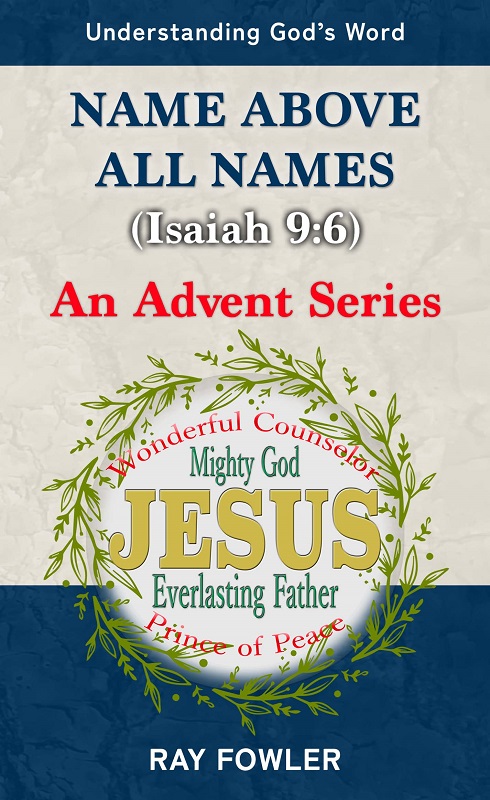


Click here for all books in the Understanding God’s Word series.
——————————–
1 Corinthians 11:23-26
23 For I received from the Lord what I also passed on to you: The Lord Jesus, on the night he was betrayed, took bread, 24 and when he had given thanks, he broke it and said, “This is my body, which is for you; do this in remembrance of me.” 25 In the same way, after supper he took the cup, saying, “This cup is the new covenant in my blood; do this, whenever you drink it, in remembrance of me.” 26 For whenever you eat this bread and drink this cup, you proclaim the Lord’s death until he comes.
INTRODUCTION: I have been in many churches and celebrated communion in many different ways. But one thing they have all had in common was the table. There always seems to be a communion table of sorts. They may come in different sizes and styles – some simple, some fancy, some decorative, some plain – but there is almost always a table.
You might wonder, what is the significance of this table that holds the elements of communion, the bread and the cup? It is significant because a table is a place where we gather together, often to share a meal. I guess a table is not absolutely necessary for communion. But it is good to remember that the first communion took place around a table, in particular, a dinner table. And that’s why the Bible calls communion both the Lord’s Supper (1 Corinthians 11:20) and the Lord’s Table (1 Corinthians 10:21).
So let’s take a closer look at the Lord’s Table this morning. What is significant about gathering around the Lord’s Table for communion?
I. A place to remember Jesus (23-25)
The Lord’s Table is first and foremost a place to remember Jesus. When Jesus sat around the table with his disciples and gave them the bread and the cup, twice he told them, “Do this in remembrance of me.” Short and simple, when we take communion, we think of Jesus. He is our focus. He is our reason for being here. We remember him.
There are three things in particular we should think about as we remember Jesus at the Lord’s Table:
A. Remember his sufferings.
– 1 Corinthians 11:23-24
First of all, we should remember his sufferings. Look at verses 23-24 where the apostle Paul writes: “For I received from the Lord what I also passed on to you: The Lord Jesus, on the night he was betrayed, took bread, and when he had given thanks, he broke it and said, ‘This is my body, which is for you; do this in remembrance of me.’” (1 Corinthians 11:23-24)
The breaking of the bread is significant in communion. It was only after Jesus broke the bread that he told his disciples, “This is my body, which is for you.” (1 Corinthians 11:24) And so it is not just the bread, but the broken bread that represents Christ’s sufferings in his body.
As we take the bread that has been broken we should remember Jesus’ sufferings. But we should especially remember his physical sufferings in the body. We should remember his agony of prayer in the Garden of Gethsemane. We should remember his unlawful arrest in the middle of the night. We should remember his unfair trial and the false accusations brought against him. We should remember Judas’ betrayal, Peter’s denial and his disciples abandoning him at his greatest hour of human need.
We should remember the brutal treatment he received at the hands of the soldiers. We should remember the mocking, the blindfolding, the spitting, the beating with fists, the slap in the face, the crown of thorns pushed into his skull. We should remember the whipping and scourging by the Roman guards, the carrying of the cross, the nailing of the hands and feet. Jesus broke the bread and told his disciples, “This is my body, which is for you.” (1 Corinthians 11:24)
B. Remember his death on the cross.
– 1 Corinthians 11:25
Secondly, we should remember Jesus’ death on the cross. We read that after Jesus gave his disciples the bread, “In the same way after supper he took the cup, saying, ‘This cup is the new covenant in my blood; do this, whenever you drink it, in remembrance of me.’” (1 Corinthians 11:25) The cup is a reminder of Jesus’ death. It is a symbol of Jesus’ blood poured out in death upon the cross.
The pouring out of blood in Scripture is always a symbol of violent death. And so the cup is a reminder not only that Jesus died, but that he was killed. Jesus did not die of old age or accident or illness. He was executed for a crime he did not commit. He was killed in one of the most brutal and painful methods known to man. He experienced nerve damage from the nails, hunger, thirst, exhaustion, and slow suffocation upon the cross. The cup is a reminder of all this. As we take the cup we should remember Jesus’ death upon the cross.
C. Remember why he did it – for our sins.
– Matthew 26:28
But there is a third thing we should remember as we take communion. We should remember why Jesus suffered and died. He did it for us. He did it for our sins. The gospel of Matthew records Jesus’ words in this way as he gave his disciples the cup: “This is my blood of the covenant, which is poured out for many for the forgiveness of sins.” (Matthew 26:28)
Jesus did not go unwillingly to the cross. He did not just die a martyr’s death. He went to the cross for a purpose. He went there to die in our place so that our sins might be forgiven. This is why we pause before taking communion to examine our lives and to confess our sin before the Lord. We remember why Jesus suffered and died – so that we might be forgiven for our sins.
II. A place to celebrate God’s forgiveness and grace (25)
And that leads us to our second point this morning. The Lord’s Table is not only a place to remember Jesus. It is also a place to celebrate God’s forgiveness and grace.
A. Thank God for the forgiveness of sins.
– 1 Corinthians 11:25
If communion was only about remember Jesus’ suffering and death, then that would make communion a pretty depressing time. There is a solemn side to communion, but communion should also be a time of celebration. We were separated from God because of our sins, but Christ died so that we might be forgiven! Praise the Lord!
And so communion is a time to thank God for the forgiveness of sins. Jesus said, “This cup is the new covenant in my blood; do this, whenever you drink it, in remembrance of me.” (1 Corinthians 11:25) The old covenant required the sacrifice of animals as prescribed by the law. But God made a new covenant with us in Jesus. Jesus was the final sacrifice for sins, and whoever puts their faith in him is forgiven.
So thank God the Father for his great love in sending Christ. Thank God the Son for laying down his life for you. Thank God the Holy Spirit for coming into your life and washing you clean. Thank God for the forgiveness of sins.
B. Marvel in God’s gracious invitation to come.
– John 6:35-37
Not only that, but marvel in God’s gracious invitation to come. God did not have to invite you to his table. But he did. Jesus declared: “I am the bread of life. He who comes to me will never go hungry, and he who believes in me will never be thirsty … All that the Father gives me will come to me, and whoever comes to me I will never drive away.” (John 6:35-37)
If you are a believer in Jesus Christ this morning, it is because Jesus first invited you to come. God the Father has graciously drawn you to himself and sat you down at the table with his Son, not because of anything righteous that you have done, but simply by his own goodness and grace. Salvation is not by works. It is the gracious gift of God which is received by faith in Jesus Christ. And so the Lord’s Table is a place of celebration – a place to celebrate God’s forgiveness and grace.
III. A place to share in Christian fellowship
And then thirdly, it is also a place to share in Christian fellowship. Now Christian fellowship always has two dimensions – both the vertical and the horizontal.
A. We share in fellowship with Christ.
– Psalm 34:8; 1 Peter 2:2-3
First there is the vertical dimension. We share in fellowship with the risen Christ. There is a reason why we actually eat the bread and drink the cup in communion. Have you ever thought about that? If the Lord’s Supper was just a time to remember Jesus and celebrate God’s forgiveness, we wouldn’t have to eat or drink anything. We could simply lay out the bread and the cup as reminders. We could break the bread to symbolize Christ’s sufferings and pour out the cup to symbolize his death.
But Jesus instructs us to eat the bread and drink the cup. Why is that? Because in partaking of the Lord’s Supper, we share in fellowship with Christ. Just as food and drink nourish us physically, so Christ nourishes us spiritually. He is the vine; we are the branches. We get our spiritual life from him. The Bible says, “Taste and see that the Lord is good.” (Psalm 34:8; 1 Peter 2:2-3) Not taste physically, but rather, come experience fellowship with Christ and see that he is good.
Now there are three basic views on how we share in fellowship with Christ through the Lord’s Supper – one which should be rejected and two which are valid interpretations of Scripture.
The first view we could call the physical presence of Christ in the elements. This is also known as the doctrine of transubstantiation which teaches that the bread and the wine are physically changed into the body and blood of Jesus, so that you are feeding upon Christ’s actual body and blood in the Lord’s Supper. We do not believe this is what the Bible teaches, and this view should be rejected.
Others believe there is a spiritual presence of Christ in the bread and in the cup, that Christ is spiritually present in the elements as you take them. That’s not my personal view, although it is a valid interpretation from Scripture which is held by many Christians in many churches.
I believe the Bible teaches the memorial presence of Christ in the Lord’s Supper, that Christ is present among us in a special way when we share the Lord’s Supper together, but that there is nothing magical or supernatural in the elements themselves. The bread remains bread. The grape juice remains grape juice. These are symbols of Christ’s suffering and death, and as we partake of them and take them into our bodies, they are a reminder of the rich fellowship we share with Christ through the Holy Spirit who dwells within us.
So that is the vertical dimension of Christian fellowship that takes place in communion. We share in fellowship with Christ.
B. We share in fellowship with each other.
– 1 Corinthians 10:17
But there is also the horizontal dimension of Christian fellowship. We share in fellowship with each other.
Notice that we do not eat the bread and drink the cup alone. We share in the Lord’s Supper together. The bread is not only symbolic of Christ’s body and sufferings but also of the church. 1 Corinthians 10:17 says this: “Because there is one loaf, we, who are many, are one body, for we all partake of the one loaf.” As believers in Christ who partake of the one loaf together, we are reminded that Christ lives within each one of us through the Holy Spirit. And so we have fellowship with each other.
True Christian fellowship always has both this vertical and this horizontal dimension. We share in fellowship with Christ, and we share in fellowship with each other. The Lord’s Table is a place to share in Christian fellowship together.
IV. A place to anticipate Christ’s return (26)
And then finally, the Lord’s Table is a place to anticipate Christ’s return.
A. Jesus proclaimed the coming of God’s kingdom.
– Luke 22:18
When Jesus shared the Last Supper with his disciples, he told them, “I tell you I will not drink again of the fruit of the vine until the kingdom of God comes.” (Luke 22:18)
Jesus proclaimed the coming of God’s kingdom. In one sense the kingdom arrived when Jesus arrived in our world 2000 years ago. But that was just the beginning. God’s kingdom continues to advance in this world through the Holy Spirit in the church and in the lives of believers. But the kingdom will not come in its fullness until Christ returns and makes all things right.
B. We proclaim the Lord’s death until he comes.
– 1 Corinthians 11:26
And so the Lord’s Supper has a forward thrust to it. That’s why Paul says in 1 Corinthians 11:26: “Whenever you eat this bread and drink this cup, you proclaim the Lord’s death until he comes.” (1 Corinthians 11:26) And so the Lord’s Supper not only looks backwards in history to Christ and the cross. It also looks forward in time to when Christ will return. We remember Jesus and what he has done for us. And we look forward to Jesus and his soon return.
CONCLUSION: I would like to close with an invitation this morning. It is a dinner invitation of sorts. All are invited; all are welcome. It is an invitation to come to the Lord’s table.
The only requirement is that you come through faith in Jesus Christ.
- Come remembering Jesus’ suffering and death and that he did it for you – to save you from your sins.
- Come celebrating God’s forgiveness and grace as you receive God’s gift of salvation through faith in Christ.
- Come sharing in Christian fellowship with Christ in heaven and your brothers and sisters in Christ here on earth.
- Come anticipating Christ’s return – when Jesus will make all things right again, and you will go to be with God forever.
Come to Christ. Come to Jesus. Come to the table of our Lord.
© Ray Fowler
You are permitted and encouraged to reproduce and distribute this message provided that you do not alter the wording in any way and that you do not charge a fee beyond the cost of reproduction. For any web postings, please link to the sermon directly at this website.
Please include the following statement on any distributed copies:
By Ray Fowler. © Ray Fowler. Website: https://www.rayfowler.org
Click here for more Communion Sermons.
Click here to return to the Sermons page.
Recent Discussion